"What if scaling reads didn’t require replicas, rewrites, or added infrastructure complexity? This post walks you through running Readyset—a caching layer purpose-built for real-time SQL acceleration—on Azure VM with MySQL. In just a few commands, you'll launch a MySQL database, deploy Readyset, and witness query speeds drop from milliseconds to microseconds." Prerequisites Before we dive in, ensure you're authenticated with Azure and have a role that includes permission to: * Create Azure

Michael Virga
2025-04-28 · 6 min read
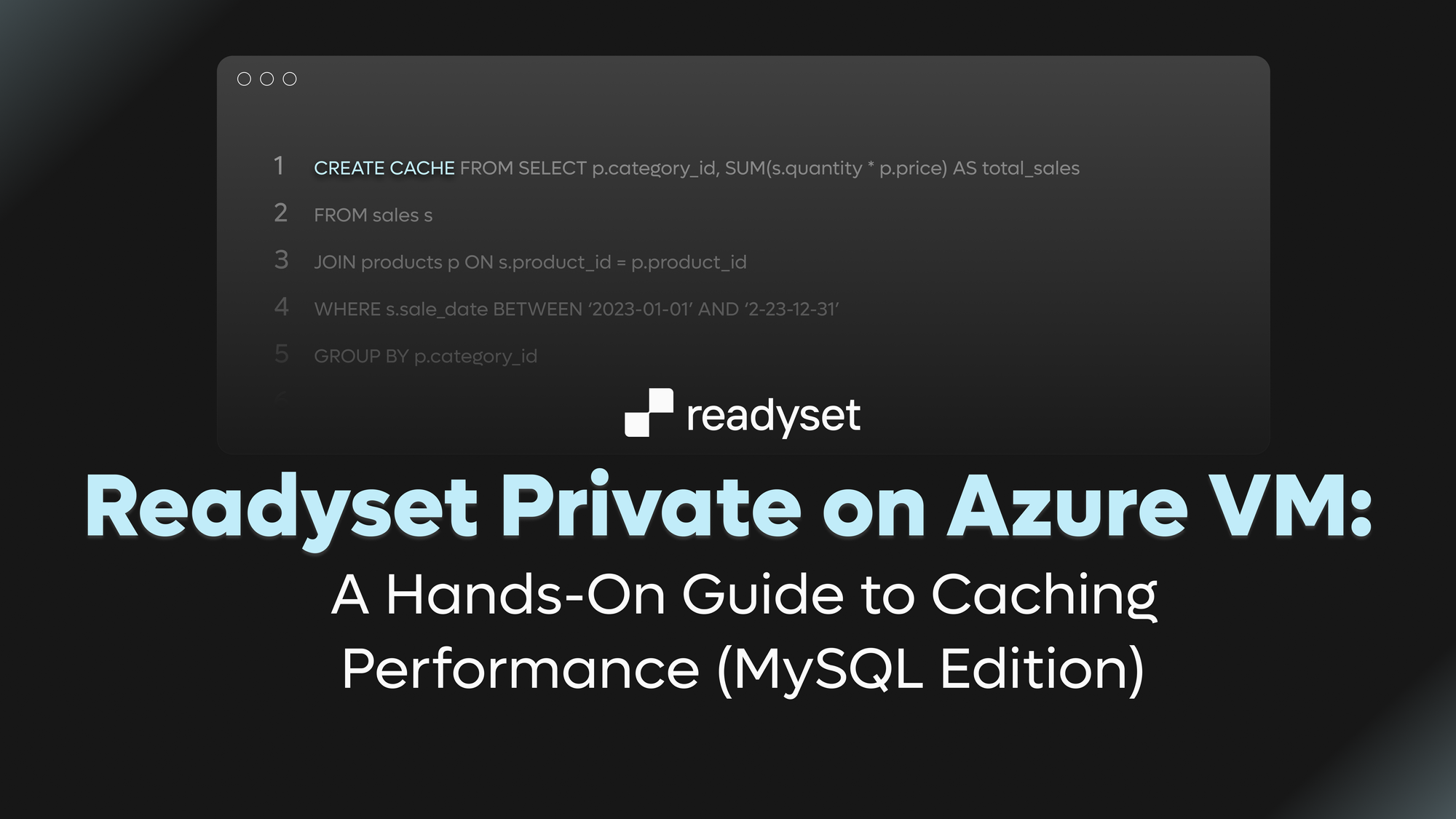
"What if scaling reads didn’t require replicas, rewrites, or added infrastructure complexity? This post walks you through running Readyset—a caching layer purpose-built for real-time SQL acceleration—on Azure VM with MySQL. In just a few commands, you'll launch a MySQL database, deploy Readyset, and witness query speeds drop from milliseconds to microseconds."
Before we dive in, ensure you're authenticated with Azure and have a role that includes permission to:
Install the Azure CLI and run:
az login
az account set --subscription <your-subscription-id>
Before creating a MySQL server, ensure the MySQL namespace is registered for your subscription:
az provider register --namespace Microsoft.DBforMySQL
This step is required only once per subscription. If not done, you may encounter a MissingSubscriptionRegistration error.
In Azure, a resource group acts as a logical container for related resources like databases, virtual machines, and networking components. Grouping resources makes management and cleanup easier, especially for demos or projects with a defined lifecycle.
az group create --name readyset-demo-rg --location centralus
az mysql flexible-server create \
  --name readyset-mysql-demo \
  --resource-group readyset-demo-rg \
  --location centralus \
  --admin-user readyset \
  --admin-password "********" \
  --sku-name Standard_B1ms \
  --public-access 0.0.0.0-255.255.255.255
If successfully created, you should be able to view the database directly in the azure portal.
Now retrieve the hostname of the database server:
az mysql flexible-server show \
  --name readyset-mysql-demo \
  --resource-group readyset-demo-rg \
  --query fullyQualifiedDomainName
Verify the MYSQL connection:
mysql -h <mysql-host-name> -u readyset -p --ssl-mode=REQUIRED
Create a new database and load it with the readyset quickstart IMDB dataset:
curl -L -O "https://readyset.io/quickstart/imdb-mysql.sql"
mysql -h <mysql-host-name> -u readyset -p --ssl-mode=REQUIRED -e "CREATE DATABASE imdb;"
mysql -h <mysql-host-name> -u readyset -p --ssl-mode=REQUIRED imdb < imdb-mysql.sql
Note: After loading the dataset, ensure the titlebasics table has a primary key on tconst (to avoid Azure's hidden primary key).
ALTER TABLE imdb.title_basics DROP COLUMN my_row_id, ADD PRIMARY KEY (tconst);
Step 1: Provision a simple Ubuntu VM to run Readyset:
az vm create \
  --name readyset-node \
  --resource-group readyset-demo-rg \
  --image Ubuntu2204 \
  --admin-username azureuser \
  --admin-password "********" \
  --authentication-type password \
  --size Standard_B1ms
SSH into the instance:
You can connect using password authentication via the public IP of the VM.
az vm show \
  --name readyset-node \
  --resource-group readyset-demo-rg \
  --show-details \
  --query publicIps \
  --output tsv
ssh azureuser@<public-ip>
sudo apt update
sudo apt install -y mysql-client-core-8.0
wget https://github.com/readysettech/readyset/releases/download/stable-250327/readyset_1.13.0-1_amd64.deb
dpkg -i readyset_1.13.0-1_amd64.deb
Download the Azure Database for MySQL CA certificate (note: all Azure Flexible MYSQL Databases require an SSL cert in order to connect):
sudo mkdir -p /etc/readyset/certs
curl -o /etc/readyset/certs/BaltimoreCyberTrustRoot.crt.pem https://www.digicert.com/CACerts/BaltimoreCyberTrustRoot.crt.pem
Launch Readyset with the following command:
/usr/bin/readyset \
  --database-type mysql \
  --query-caching explicit \
  --address 0.0.0.0:3307 \
  --disable-telemetry \
  --authority standalone \
  --cache-ddl-address 127.0.0.1:5434 \
  --query-log-mode verbose \
  --prometheus-metrics \
  --feature-post-lookup \
  --feature-full-materialization \
  --ssl-root-cert /etc/readyset/certs/BaltimoreCyberTrustRoot.crt.pem \
  --upstream-db-url 'mysql://readyset:********@readyset-mysql-demo.mysql.database.azure.com:3306/imdb' > readyset.log 2>&1 &
Note: this will run Readyset in a detached state so that we can connect to it from the same terminal window. Any unexpected startup errors will be visible in readyset.log
With Readyset running, let's walk through caching a query and observing the performance improvement.
Connect to Readyset via it’s caching ddl port (note: connecting on this port is necessary for applications to cache queries):
mysql -h 127.0.0.1 -P 5434 -u readyset -p******** -D imdb --protocol=TCP
The below query grabs the top 10 movies between the years 1950 and 2000 where the number of votes is greater than 1000, sorted by average rating:
SELECT title_basics.primarytitle, title_basics.startyear, title_ratings.numvotes, title_ratings.averagerating
FROM title_basics
JOIN title_ratings ON title_basics.tconst = title_ratings.tconst
WHERE title_basics.startyear BETWEEN 1950 AND 2000
AND title_basics.titletype = 'movie'
AND title_ratings.numvotes > 1000
ORDER BY title_ratings.numvotes DESC
LIMIT 10;
Before caching, this query takes an average of ~800 - ~1700 ms depending on active database load.
To cache a query in readyset, identify the query's ID for caching:
SHOW PROXIED QUERIES;
Note: the ‘readyset supported’ column indicates whether the query can be cached. If you’ve loaded your own dataset and sent Readyset a custom query, try to cache the query and observe the output. If the query is not supported it will provide a reason and tips to modify the query so it can be cached.
Create a cache for the query
CREATE CACHE FROM <query_id>;
Then confirm that it has been successfully cached
SHOW CACHES;
Run the same query again and observe the reduced execution time (e.g., <0.01 seconds).
This is a small demonstration of the power of Readyset's caching acceleration. Instead of proxying the query to your upstream MySQL database, Readyset serves query results directly from its intelligent, materialized cache. This not only accelerates query performance dramatically but also reduces the general load on your primary database.
Unlike traditional caching mechanisms (e.g., Redis or manual materialized views), Readyset automatically keeps cached results up to date by listening to the database's change streams (binlog for MySQL or WAL for Postgres). This ensures your application always gets fresh, low-latency responses without complex invalidation logic.
Once you're done, you can delete the entire resource group to remove all associated resources (MySQL flexible server, VM, networking, etc.):
az group delete --name readyset-demo-rg --yes --no-wait
This ensures you don't incur any ongoing charges for the resources created in this demo.
While this guide focused on deploying Readyset alongside Azure MySQL, Readyset is a platform-independent solution. It integrates seamlessly with MySQL and PostgreSQL deployments—whether they run on Azure, AWS, GCP, or on-premises environments. You can introduce Readyset into your existing infrastructure without rewriting your application code.
Additionally, the Readyset team is actively working on expanding support for native cloud deployments across providers, including Azure. Soon, you'll be able to deploy Readyset clusters directly into Readyset's managed environment, or directly into your own cloud account for even simpler setup and scaling.
By leveraging Readyset, you gain:
Try Readyset today and see how easily it can slot into your data architecture to turbocharge your SQL performance–without any code changes!
Questions, comments? Join the discussion on Readyset community slack channel here or sign up for a demo and free query assessment here. You can also follow us on LinkedIn.
Related articles
Continue reading more about uncategorized.
Readyset has always been about making database scaling effortless. Today, we’re extending that mission from the server to the developer’s terminal with rdst, a production-native, AI-powered CLI that helps teams write better queries, diagnose performance issues, and close the loop on caching, all before bad queries ever reach production. The Database Scaling Problem Is a Query Problem Every engineering team eventually hits the same wall: the database can’t keep up. Latency spikes. CPU climbs.
Why Query Rewriting Matters for Dataflow Most databases work the same way: a query arrives, the engine builds an execution plan, scans tables, joins rows, filters, aggregates, and returns the result. Every time the query runs, the work repeats from scratch. This pull-based model has served relational databases for decades, but it carries an inherent cost: read latency is proportional to the complexity of the query and the size of the data it touches. Readyset takes a fundamentally different ap
 Vassili Zarouba
Most LLM-generated SQL doesn't fail. It runs and returns results, and that's exactly what makes it dangerous. The errors don't surface until they're already in your data. AI-assisted development has made it easier than ever to generate SQL quickly. The problem is that quick and correct are not the same thing, and with databases, the gap between the two has consequences that compound quietly over time. SQL that runs is not the same as SQL that works. LLMs are good at producing SQL that looks ri
Modern applications demand instant performance, even under unpredictable load. Readyset helps you eliminate slow queries, stabilize latency, and scale confidently.
Revolutionize your database performance with Readyset
Serve requests at sub-millisecond latencies with the modern database scaling and query caching system for MySQL and PostgreSQL.
Join our newsletter
Stay updated with the latest news, insights, and developments from Readyset — straight to your inbox.