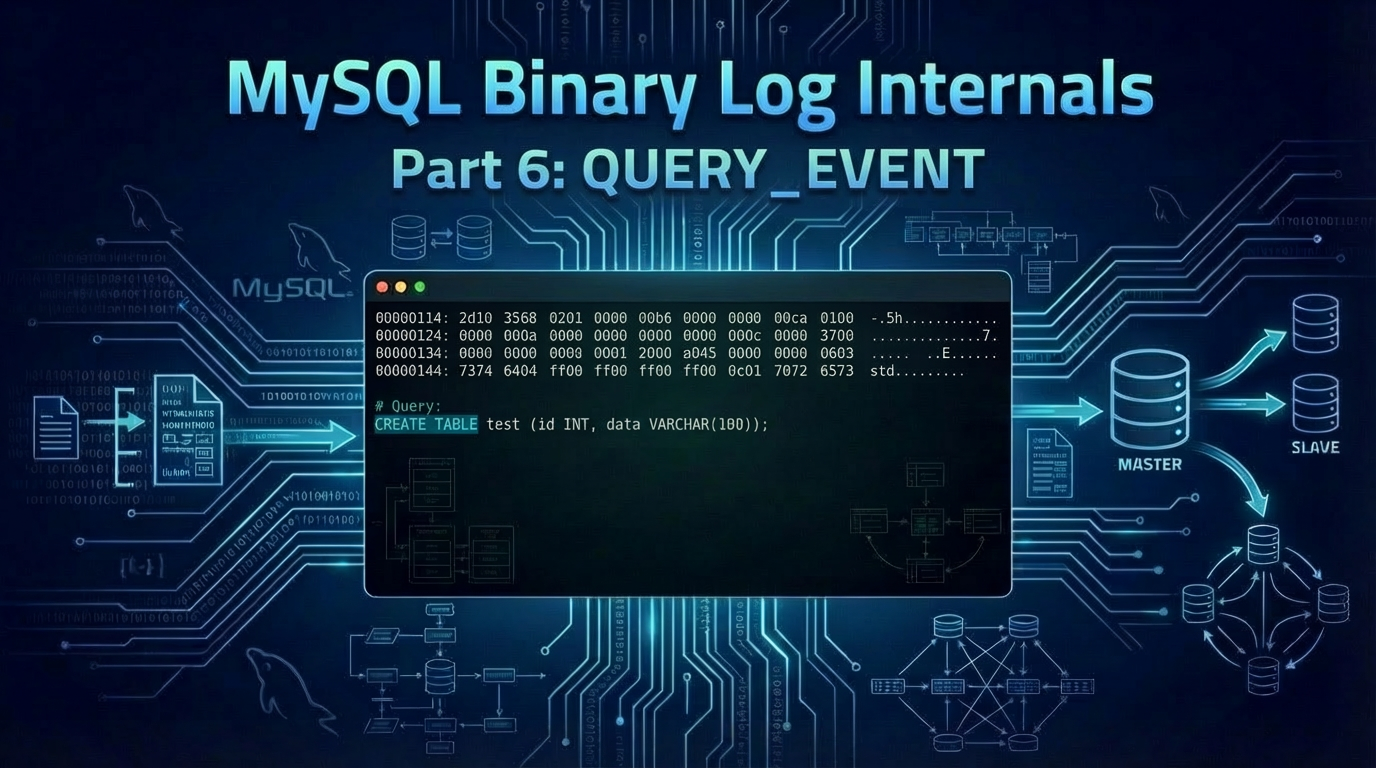
In this sixth post of our series, we decode the QUERY_EVENT — the workhorse event that records DDL statements and transaction boundaries. Introduction The QUERY_EVENT (event type 2, 0x02) is one of the most versatile events in a binary log. It records: * DDL statements: CREATE, ALTER, DROP, TRUNCATE, etc. * Transaction boundaries: BEGIN statements that start a transaction * Statement-based DML: In statement-based replication mode, INSERT/UPDATE/DELETE Even in row-based replication (the d

Marcelo Altmann
2026-04-01 · 16 min read
In this sixth post of our series, we decode the QUERY_EVENT — the workhorse event that records DDL statements and transaction boundaries.
The QUERY_EVENT (event type 2, 0x02) is one of the most versatile events in a binary log. It records:
Even in row-based replication (the default since MySQL 5.7), DDL statements are always logged as QUERY_EVENTs because their effects can't be represented as row changes.
In our binary log, we have several QUERY_EVENTs:
Position   276: QUERY_EVENT (182 bytes) - CREATE TABLE
Position   537: QUERY_EVENT (83 bytes)  - BEGIN (for INSERT)
Position   847: QUERY_EVENT (92 bytes)  - BEGIN (for UPDATE)
Position  1189: QUERY_EVENT (83 bytes)  - BEGIN (for DELETE)
Let's decode both types: the DDL (CREATE TABLE) and the transaction boundary (BEGIN).
Let's start with the CREATE TABLE event at position 276:
2d103568 02 01000000 b6000000 ca010000 0000
│        │  │        │        │        │
│        │  │        │        │        └─→ Flags: 0x0000
│        │  │        │        └───────────→ Next Position: 458
│        │  │        └────────────────────→ Event Size: 182 bytes
│        │  └─────────────────────────────→ Server ID: 1
│        └────────────────────────────────→ Event Type: 2 (QUERY_EVENT)
└─────────────────────────────────────────→ Timestamp: 1748308013
| Field | Bytes | Little-Endian | Value |
|---|---|---|---|
| Timestamp | 2d103568 | 0x6835102d | 1748308013 (2025-05-27 01:06:53) |
| Event Type | 02 | 0x02 | 2 (QUERY_EVENT) |
| Server ID | 01000000 | 0x00000001 | 1 |
| Event Size | b6000000 | 0x000000b6 | 182 bytes |
| Next Position | ca010000 | 0x000001ca | 458 |
| Flags | 0000 | 0x0000 | No flags |
The common header flags field is a bitmask. For QUERY_EVENTs, the most relevant flags are:
| Flag | Value | Meaning |
|---|---|---|
| LOG_EVENT_THREAD_SPECIFIC_F | 0x04 | Query depends on a thread-specific value (e.g., uses TEMPORARY TABLE) |
| LOG_EVENT_SUPPRESS_USE_F | 0x08 | Don't prepend USE database before executing the query on the replica |
| LOG_EVENT_ARTIFICIAL_F | 0x20 | Artificially generated event — don't update the master log position |
| LOG_EVENT_RELAY_LOG_F | 0x40 | Event was created by the replica's IO thread (written to relay log) |
| LOG_EVENT_IGNORABLE_F | 0x80 | Event can be safely ignored by older replicas that don't understand it |
| LOG_EVENT_NO_FILTER_F | 0x100 | Event is not affected by replication filters |
| LOG_EVENT_MTS_ISOLATE_F | 0x200 | Forces isolation in the multi-threaded replica applier |
Our CREATE TABLE event has flags 0x0000 — no special flags set. As we'll see later, the BEGIN events have 0x0008 (LOG_EVENT_SUPPRESS_USE_F) set.
$ xxd -s 276 -l 182 binlog.000024
00000114: 2d10 3568 0201 0000 00b6 0000 00ca 0100  -.5h............
00000124: 0000 000a 0000 0000 0000 000c 0000 3700  ..............7.
00000134: 0000 0000 0001 2000 a045 0000 0000 0603  ...... ..E......
00000144: 7374 6404 ff00 ff00 ff00 0c01 7072 6573  std.........pres
00000154: 656e 7461 7469 6f6e 0011 3600 0000 0000  entation..6.....
00000164: 0000 12ff 0013 0070 7265 7365 6e74 6174  .......presentat
00000174: 696f 6e00 4352 4541 5445 2054 4142 4c45  ion.CREATE TABLE
00000184: 2070 6572 736f 6e20 280a 2020 4944 2049   person (.  ID I
00000194: 4e54 2050 5249 4d41 5259 204b 4559 2c0a  NT PRIMARY KEY,.
000001a4: 2020 6e61 6d65 2056 4152 4348 4152 2831    name VARCHAR(1
000001b4: 3530 2920 4445 4641 554c 5420 4e55 4c4c  50) DEFAULT NULL
000001c4: 0a29 0536 a92b                           .).6.+
The event is 182 bytes: 19-byte common header + 13-byte post-header + 55-byte status variables + 13-byte database name + 78-byte query + 4-byte checksum.
The QUERY_EVENT has a 13-byte post-header (QUERY_HEADER_LEN) followed by variable-length data:
| Field | Size | Description |
|---|---|---|
| Post-Header (13 bytes) | ||
| Thread ID | 4 bytes | ID of the thread that executed the query |
| Execution Time | 4 bytes | Time in seconds the query took to execute |
| Database Length | 1 byte | Length of the default database name (max 255) |
| Error Code | 2 bytes | MySQL error code (0 for success) |
| Status Vars Length | 2 bytes | Length of the status variables block |
| Data Body | ||
| Status Variables | Variable | Session settings (SQL mode, character set, etc.) — Type-Value encoded |
| Database Name | Variable | Null-terminated default database (db_len + 1 bytes) |
| Query | Variable | The SQL statement (not null-terminated) |
The query length is computed from the remaining bytes: event_size - 19 - 13 - status_vars_len - db_len - 1 - 4(checksum).
0a000000 00000000 0c 0000 3700
│        │        │  │    │
│        │        │  │    └─→ Status Vars Length: 55 bytes
│        │        │  └───────→ Error Code: 0 (success)
│        │        └──────────→ Database Length: 12 ("presentation")
│        └───────────────────→ Execution Time: 0 seconds
└────────────────────────────→ Thread ID: 10
| Field | Bytes | Value |
|---|---|---|
| Thread ID | 0a000000 | 10 |
| Execution Time | 00000000 | 0 seconds |
| Database Length | 0c | 12 bytes |
| Error Code | 0000 | 0 (success) |
| Status Vars Length | 3700 | 55 bytes |
The Thread ID identifies the connection that ran the query. The Execution Time records how long the query took to execute on the source — replicas can use this to estimate replication lag. The Error Code is non-zero when a query that produces an error is intentionally replicated (e.g., DROP TABLE IF NOT EXISTS on a table that doesn't exist produces error 1051, but is still logged).
Status variables carry session state that the replica needs to replay the query correctly. They are encoded as Type-Value pairs: a 1-byte type code followed by a value whose size depends on the type. The type codes are defined in Query_event_status_vars.
Note: Unlike TLV (Type-Length-Value) encoding from Part 1, status variables do not carry a length field. The size of each type code's value is hardcoded in the deserialization switch statement. This means a parser that encounters an unknown type code cannot skip over it — it has no way to determine how many bytes the value occupies. The MySQL parser handles this by stopping the status variable parse at that point.
Here are the status variables in our CREATE TABLE event:
00 00000000 01 2000a04500000000 06 03 737464 04 ff00ff00ff00
0c 01 70726573656e746174696f6e 00 11 3600000000000000 12 ff00 13 00
| Offset | Type | Name | Raw Bytes | Decoded Value |
|---|---|---|---|---|
| 0 | 0x00 | Q_FLAGS2_CODE | 00 00000000 | 0x00000000 — no session flags set |
| 5 | 0x01 | Q_SQL_MODE_CODE | 01 2000a04500000000 | 0x0000000045a00020 |
| 14 | 0x06 | Q_CATALOG_NZ_CODE | 06 03 737464 | length=3, "std" |
| 19 | 0x04 | Q_CHARSET_CODE | 04 ff00 ff00 ff00 | client=255, connection=255, server=255 |
| 26 | 0x0c | Q_UPDATED_DB_NAMES | 0c 01 707265...00 | count=1, ["presentation"] |
| 41 | 0x11 | Q_DDL_LOGGED_WITH_XID | 11 3600000000000000 | xid=54 |
| 50 | 0x12 | Q_DEFAULT_COLLATION_FOR_UTF8MB4 | 12 ff00 | collation=255 (utf8mb4_0900_ai_ci) |
| 53 | 0x13 | Q_SQL_REQUIRE_PRIMARY_KEY | 13 00 | 0 (not required) |
Let's look at the most important ones in detail.
4-byte bitmask of session options from OPTIONS_WRITTEN_TO_BIN_LOG:
| Bit | Flag | Meaning |
|---|---|---|
| 14 | OPTION_AUTO_IS_NULL | @@sql_auto_is_null behavior — SELECT * WHERE id IS NULL returns the last inserted auto-inc row |
| 19 | OPTION_NOT_AUTOCOMMIT | @@autocommit = 0 — transactions are not auto-committed |
| 26 | OPTION_NO_FOREIGN_KEY_CHECKS | @@foreign_key_checks = 0 — foreign key constraints are not enforced |
| 27 | OPTION_RELAXED_UNIQUE_CHECKS | @@unique_checks = 0 — unique index constraints are not enforced |
In our event, flags2 = 0x00000000 — all defaults (autocommit on, FK checks on, unique checks on).
8-byte bitmask representing @@sql_mode. The value 0x0000000045a00020 decodes to these active flags:
| Bit | Flag |
|---|---|
| 5 | MODE_ONLY_FULL_GROUP_BY |
| 21 | MODE_STRICT_TRANS_TABLES |
| 23 | MODE_NO_ZERO_IN_DATE |
| 24 | MODE_NO_ZERO_DATE |
| 26 | MODE_ERROR_FOR_DIVISION_BY_ZERO |
| 30 | MODE_NO_ENGINE_SUBSTITUTION |
1-byte length prefix followed by the catalog string (no null terminator). Currently, MySQL only has one catalog: "std". This field exists for forward compatibility.
6 bytes encoding three 2-byte little-endian collation IDs:
| Bytes | Field | Value | Meaning |
|---|---|---|---|
| ff00 | character_set_client | 255 | utf8mb4_0900_ai_ci |
| ff00 | collation_connection | 255 | utf8mb4_0900_ai_ci |
| ff00 | collation_server | 255 | utf8mb4_0900_ai_ci |
These ensure the replica uses the same character set settings when executing the query, so that string comparisons and conversions produce identical results.
8-byte XID value. This is the internal transaction ID assigned to the DDL statement, making DDL crash-safe. In our event, xid=54. This field is only present for DDL statements (CREATE, ALTER, DROP, etc.), not for BEGIN queries.
For completeness, here is the full list of all status variable types defined in Query_event_status_vars:
| Code | Name | Size | Description |
|---|---|---|---|
| 0 | Q_FLAGS2_CODE | 4 bytes | Session flags bitmask |
| 1 | Q_SQL_MODE_CODE | 8 bytes | SQL mode bitmask |
| 2 | Q_CATALOG_CODE | 1 + N + 1 bytes | Legacy catalog (with null terminator, MySQL 5.0.0–5.0.3 only) |
| 3 | Q_AUTO_INCREMENT | 4 bytes | Two uint16: auto_increment_increment and auto_increment_offset |
| 4 | Q_CHARSET_CODE | 6 bytes | Three uint16: client charset, connection collation, server collation |
| 5 | Q_TIME_ZONE_CODE | 1 + N bytes | Time zone name (length-prefixed string) |
| 6 | Q_CATALOG_NZ_CODE | 1 + N bytes | Catalog name (length-prefixed, no null terminator) |
| 7 | Q_LC_TIME_NAMES_CODE | 2 bytes | Locale number for lc_time_names |
| 8 | Q_CHARSET_DATABASE_CODE | 2 bytes | Database default collation |
| 9 | Q_TABLE_MAP_FOR_UPDATE_CODE | 8 bytes | 64-bit table map for multi-table UPDATE |
| 10 | Q_MASTER_DATA_WRITTEN_CODE | 4 bytes | Placeholder — unused after MySQL 8.0.2 |
| 11 | Q_INVOKER | 1 + N + 1 + N bytes | DEFINER's user and host (for stored routines, views, triggers) |
| 12 | Q_UPDATED_DB_NAMES | 1 + variable | Count of accessed databases + null-terminated names (for parallel replication) |
| 13 | Q_MICROSECONDS | 3 bytes | Microsecond component of the query timestamp |
| 14 | Q_COMMIT_TS | — | Obsolete (unused) |
| 15 | Q_COMMIT_TS2 | — | Obsolete (unused) |
| 16 | Q_EXPLICIT_DEFAULTS_FOR_TIMESTAMP | 1 byte | @@explicit_defaults_for_timestamp value |
| 17 | Q_DDL_LOGGED_WITH_XID | 8 bytes | Internal XID for crash-safe DDL |
| 18 | Q_DEFAULT_COLLATION_FOR_UTF8MB4 | 2 bytes | Default utf8mb4 collation (for cross-version replication) |
| 19 | Q_SQL_REQUIRE_PRIMARY_KEY | 1 byte | @@sql_require_primary_key value |
| 20 | Q_DEFAULT_TABLE_ENCRYPTION | 1 byte | @@default_table_encryption value |
After the status variables, we have the database name (null-terminated):
70 72 65 73 65 6e 74 61 74 69 6f 6e 00
p  r  e  s  e  n  t  a  t  i  o  n  \0
Database: "presentation" (12 bytes + 1 null terminator)
The rest of the payload (before the 4-byte checksum) is the SQL statement (78 bytes, not null-terminated):
CREATE TABLE person (
  ID INT PRIMARY KEY,
  name VARCHAR(150) DEFAULT NULL
)
Transaction boundaries for row-based events are marked with a QUERY_EVENT containing "BEGIN":
$ xxd -s 537 -l 83 binlog.000024
00000219: 3210 3568 0201 0000 0053 0000 006c 0200  2.5h.....S...l..
00000229: 0008 000a 0000 0000 0000 000c 0000 1d00  ................
00000239: 0000 0000 0001 2000 a045 0000 0000 0603  ...... ..E......
00000249: 7374 6404 ff00 ff00 ff00 12ff 0070 7265  std..........pre
00000259: 7365 6e74 6174 696f 6e00 4245 4749 4e95  sentation.BEGIN.
00000269: c51d cf                                  ...
32103568 02 01000000 53000000 6c020000 0800
│        │  │        │        │        │
│        │  │        │        │        └─→ Flags: 0x0008 (LOG_EVENT_SUPPRESS_USE_F)
│        │  │        │        └───────────→ Next Position: 620
│        │  │        └────────────────────→ Event Size: 83 bytes
│        │  └─────────────────────────────→ Server ID: 1
│        └────────────────────────────────→ Event Type: 2 (QUERY_EVENT)
└─────────────────────────────────────────→ Timestamp: 1748308018
Note the flags field is 0x0008 — this is LOG_EVENT_SUPPRESS_USE_F, which tells the replica not to execute a USE database statement before this query. This makes sense — BEGIN doesn't depend on the current database.
0a000000 00000000 0c 0000 1d00
│        │        │  │    │
│        │        │  │    └─→ Status Vars Length: 29 bytes
│        │        │  └───────→ Error Code: 0
│        │        └──────────→ Database Length: 12
│        └───────────────────→ Execution Time: 0
└────────────────────────────→ Thread ID: 10
The BEGIN event has only 29 bytes of status variables (vs. 55 for CREATE TABLE) — it doesn't include Q_UPDATED_DB_NAMES, Q_DDL_LOGGED_WITH_XID, or Q_SQL_REQUIRE_PRIMARY_KEY since those are DDL-specific.
| Type | Name | Value |
|---|---|---|
| 0x00 | Q_FLAGS2_CODE | 0x00000000 |
| 0x01 | Q_SQL_MODE_CODE | 0x0000000045a00020 |
| 0x06 | Q_CATALOG_NZ_CODE | "std" |
| 0x04 | Q_CHARSET_CODE | client=255, conn=255, server=255 |
| 0x12 | Q_DEFAULT_COLLATION_FOR_UTF8MB4 | 255 |
BEGIN
Our binary log has three BEGIN events. Let's compare them:
| Position | Size | Flags | Status Vars Len | Extra Status Variables |
|---|---|---|---|---|
| 537 | 83 | 0x0008 | 29 | — |
| 847 | 92 | 0x0008 | 38 | Q_TABLE_MAP_FOR_UPDATE_CODE = 0x0000000000000001 |
| 1189 | 83 | 0x0008 | 29 | — |
The UPDATE transaction's BEGIN event (position 847) is 9 bytes larger because it includes Q_TABLE_MAP_FOR_UPDATE_CODE (1 byte type + 8 bytes value). This 64-bit bitmask identifies which tables will be modified by the transaction — the replica's multi-threaded applier uses this to determine if transactions can be applied in parallel.
Position 276: QUERY_EVENT - CREATE TABLE (182 bytes)

┌─────────────────────────────────────────────────────────────────────────┐
│                         COMMON HEADER (19 bytes)                        │
├─────────────────────────────────────────────────────────────────────────┤
│ 2d103568     │ 02   │ 01000000 │ b6000000 │ ca010000 │ 0000             │
│ Timestamp    │ Type │ ServerID │ Size     │ NextPos  │ Flags            │
│ 1748308013   │ 2    │ 1        │ 182      │ 458      │ 0x0000           │
└─────────────────────────────────────────────────────────────────────────┘

┌─────────────────────────────────────────────────────────────────────────┐
│                         POST-HEADER (13 bytes)                          │
├──────────────────────────────┬──────────────────────────────────────────┤
│ 0a000000                     │ Thread ID: 10                            │
├──────────────────────────────┼──────────────────────────────────────────┤
│ 00000000                     │ Execution Time: 0 seconds                │
├──────────────────────────────┼──────────────────────────────────────────┤
│ 0c                           │ Database Length: 12                      │
├──────────────────────────────┼──────────────────────────────────────────┤
│ 0000                         │ Error Code: 0 (success)                  │
├──────────────────────────────┼──────────────────────────────────────────┤
│ 3700                         │ Status Vars Length: 55                   │
└──────────────────────────────┴──────────────────────────────────────────┘

┌─────────────────────────────────────────────────────────────────────────┐
│                       STATUS VARIABLES (55 bytes)                       │
├──────────────────────────────┬──────────────────────────────────────────┤
│ 00 00000000                  │ Q_FLAGS2_CODE: 0x00000000                │
├──────────────────────────────┼──────────────────────────────────────────┤
│ 01 2000a04500000000          │ Q_SQL_MODE_CODE: 0x0000000045a00020      │
├──────────────────────────────┼──────────────────────────────────────────┤
│ 06 03 737464                 │ Q_CATALOG_NZ_CODE: "std"                 │
├──────────────────────────────┼──────────────────────────────────────────┤
│ 04 ff00ff00ff00               │ Q_CHARSET_CODE: 255/255/255             │
├──────────────────────────────┼──────────────────────────────────────────┤
│ 0c 01 707265...00            │ Q_UPDATED_DB_NAMES: ["presentation"]     │
├──────────────────────────────┼──────────────────────────────────────────┤
│ 11 3600000000000000          │ Q_DDL_LOGGED_WITH_XID: xid=54            │
├──────────────────────────────┼──────────────────────────────────────────┤
│ 12 ff00                      │ Q_DEFAULT_COLLATION_FOR_UTF8MB4: 255     │
├──────────────────────────────┼──────────────────────────────────────────┤
│ 13 00                        │ Q_SQL_REQUIRE_PRIMARY_KEY: 0             │
└──────────────────────────────┴──────────────────────────────────────────┘

┌─────────────────────────────────────────────────────────────────────────┐
│                       DATABASE + QUERY                                  │
├──────────────────────────────┬──────────────────────────────────────────┤
│ 70726573656e746174696f6e00   │ Database: "presentation\0" (13 bytes)    │
├──────────────────────────────┼──────────────────────────────────────────┤
│ 435245415445205441424c4520...│ Query (78 bytes):                        │
│                              │ CREATE TABLE person (                    │
│                              │   ID INT PRIMARY KEY,                    │
│                              │   name VARCHAR(150) DEFAULT NULL         │
│                              │ )                                        │
└──────────────────────────────┴──────────────────────────────────────────┘

┌─────────────────────────────────────────────────────────────────────────┐
│                           CHECKSUM (4 bytes)                            │
├──────────────────────────────┬──────────────────────────────────────────┤
│ 0536a92b                     │ CRC32                                    │
└──────────────────────────────┴──────────────────────────────────────────┘
Here's how a typical DML transaction looks in the binary log:
GTID_LOG_EVENT          ← Transaction identifier (GNO=13)
QUERY_EVENT (BEGIN)     ← Transaction start
TABLE_MAP_EVENT         ← Table metadata
WRITE_ROWS_EVENT        ← The actual row data
XID_EVENT               ← Transaction commit
For DDL statements:
GTID_LOG_EVENT          ← Transaction identifier (GNO=12)
QUERY_EVENT (DDL)       ← The DDL statement itself (implicitly committed)
Note that DDL statements don't have explicit BEGIN/COMMIT — they are implicitly committed. The Q_DDL_LOGGED_WITH_XID status variable ensures crash-safety for the DDL operation.
import struct

STATUS_VAR_NAMES = {
    0x00: ('Q_FLAGS2_CODE', 4),
    0x01: ('Q_SQL_MODE_CODE', 8),
    0x03: ('Q_AUTO_INCREMENT', 4),
    0x04: ('Q_CHARSET_CODE', 6),
    0x06: ('Q_CATALOG_NZ_CODE', None),  # variable
    0x07: ('Q_LC_TIME_NAMES_CODE', 2),
    0x08: ('Q_CHARSET_DATABASE_CODE', 2),
    0x09: ('Q_TABLE_MAP_FOR_UPDATE_CODE', 8),
    0x0c: ('Q_UPDATED_DB_NAMES', None),  # variable
    0x11: ('Q_DDL_LOGGED_WITH_XID', 8),
    0x12: ('Q_DEFAULT_COLLATION_FOR_UTF8MB4', 2),
    0x13: ('Q_SQL_REQUIRE_PRIMARY_KEY', 1),
    0x14: ('Q_DEFAULT_TABLE_ENCRYPTION', 1),
}

def decode_status_vars(data):
    """Decode QUERY_EVENT status variables (Type-Value pairs)."""
    off = 0
    while off < len(data):
        code = data[off]
        off += 1
        info = STATUS_VAR_NAMES.get(code)
        name = info[0] if info else f'UNKNOWN(0x{code:02x})'

        if code == 0x00:
            val = struct.unpack('<I', data[off:off+4])[0]
            print(f"  0x{code:02x} {name}: 0x{val:08x}")
            off += 4
        elif code == 0x01:
            val = struct.unpack('<Q', data[off:off+8])[0]
            print(f"  0x{code:02x} {name}: 0x{val:016x}")
            off += 8
        elif code == 0x04:
            c1, c2, c3 = struct.unpack('<HHH', data[off:off+6])
            print(f"  0x{code:02x} {name}: client={c1}, conn={c2}, server={c3}")
            off += 6
        elif code == 0x06:
            slen = data[off]; off += 1
            s = data[off:off+slen].decode('utf-8'); off += slen
            print(f"  0x{code:02x} {name}: \"{s}\"")
        elif code == 0x09:
            val = struct.unpack('<Q', data[off:off+8])[0]
            print(f"  0x{code:02x} {name}: 0x{val:016x}")
            off += 8
        elif code == 0x0c:
            count = data[off]; off += 1
            dbs = []
            for _ in range(count):
                end = data.index(0x00, off)
                dbs.append(data[off:end].decode('utf-8')); off = end + 1
            print(f"  0x{code:02x} {name}: {dbs}")
        elif code == 0x11:
            val = struct.unpack('<Q', data[off:off+8])[0]
            print(f"  0x{code:02x} {name}: xid={val}")
            off += 8
        elif code == 0x12:
            val = struct.unpack('<H', data[off:off+2])[0]
            print(f"  0x{code:02x} {name}: {val}")
            off += 2
        elif code == 0x13 or code == 0x14 or code == 0x10:
            val = data[off]; off += 1
            print(f"  0x{code:02x} {name}: {val}")
        else:
            print(f"  0x{code:02x} {name}: (unknown encoding, stopping)")
            break

with open('binlog.000024', 'rb') as f:
    positions = [276, 537, 847, 1189]
    labels = ["CREATE TABLE", "BEGIN (INSERT)", "BEGIN (UPDATE)", "BEGIN (DELETE)"]

    for pos, label in zip(positions, labels):
        f.seek(pos)
        header = f.read(19)
        timestamp, event_type, server_id, event_size, next_pos, flags = \
            struct.unpack('<IBIIIH', header)

        post_header = f.read(13)
        thread_id, exec_time, db_len, error_code, status_len = \
            struct.unpack('<IIBHH', post_header)

        print(f"Position {pos}: QUERY_EVENT - {label}")
        print(f"  Event Size: {event_size} bytes, Flags: 0x{flags:04x}")
        print(f"  Thread ID: {thread_id}, Exec Time: {exec_time}s, "
              f"Error Code: {error_code}")
        print(f"  Status Variables ({status_len} bytes):")

        status_vars = f.read(status_len)
        decode_status_vars(status_vars)

        db_name = f.read(db_len).decode('utf-8')
        f.read(1)  # null terminator

        query_len = event_size - 19 - 13 - status_len - db_len - 1 - 4
        query = f.read(query_len).decode('utf-8')

        print(f"  Database: \"{db_name}\"")
        print(f"  Query: \"{query}\"")
        print()
Output:
Position 276: QUERY_EVENT - CREATE TABLE
  Event Size: 182 bytes, Flags: 0x0000
  Thread ID: 10, Exec Time: 0s, Error Code: 0
  Status Variables (55 bytes):
  0x00 Q_FLAGS2_CODE: 0x00000000
  0x01 Q_SQL_MODE_CODE: 0x0000000045a00020
  0x06 Q_CATALOG_NZ_CODE: "std"
  0x04 Q_CHARSET_CODE: client=255, conn=255, server=255
  0x0c Q_UPDATED_DB_NAMES: ['presentation']
  0x11 Q_DDL_LOGGED_WITH_XID: xid=54
  0x12 Q_DEFAULT_COLLATION_FOR_UTF8MB4: 255
  0x13 Q_SQL_REQUIRE_PRIMARY_KEY: 0
  Database: "presentation"
  Query: "CREATE TABLE person (
  ID INT PRIMARY KEY,
  name VARCHAR(150) DEFAULT NULL
)"

Position 537: QUERY_EVENT - BEGIN (INSERT)
  Event Size: 83 bytes, Flags: 0x0008
  Thread ID: 10, Exec Time: 0s, Error Code: 0
  Status Variables (29 bytes):
  0x00 Q_FLAGS2_CODE: 0x00000000
  0x01 Q_SQL_MODE_CODE: 0x0000000045a00020
  0x06 Q_CATALOG_NZ_CODE: "std"
  0x04 Q_CHARSET_CODE: client=255, conn=255, server=255
  0x12 Q_DEFAULT_COLLATION_FOR_UTF8MB4: 255
  Database: "presentation"
  Query: "BEGIN"

Position 847: QUERY_EVENT - BEGIN (UPDATE)
  Event Size: 92 bytes, Flags: 0x0008
  Thread ID: 10, Exec Time: 0s, Error Code: 0
  Status Variables (38 bytes):
  0x00 Q_FLAGS2_CODE: 0x00000000
  0x01 Q_SQL_MODE_CODE: 0x0000000045a00020
  0x06 Q_CATALOG_NZ_CODE: "std"
  0x04 Q_CHARSET_CODE: client=255, conn=255, server=255
  0x09 Q_TABLE_MAP_FOR_UPDATE_CODE: 0x0000000000000001
  0x12 Q_DEFAULT_COLLATION_FOR_UTF8MB4: 255
  Database: "presentation"
  Query: "BEGIN"

Position 1189: QUERY_EVENT - BEGIN (DELETE)
  Event Size: 83 bytes, Flags: 0x0008
  Thread ID: 10, Exec Time: 0s, Error Code: 0
  Status Variables (29 bytes):
  0x00 Q_FLAGS2_CODE: 0x00000000
  0x01 Q_SQL_MODE_CODE: 0x0000000045a00020
  0x06 Q_CATALOG_NZ_CODE: "std"
  0x04 Q_CHARSET_CODE: client=255, conn=255, server=255
  0x12 Q_DEFAULT_COLLATION_FOR_UTF8MB4: 255
  Database: "presentation"
  Query: "BEGIN"
Note: The binary log files used in this series (
binlog.000024,binlog_gtid_tag.000001, and others) are available at github.com/altmannmarcelo/presentations/tree/main/binlog.
MODE_* bitmask valuesQ_FLAGS2_CODELOG_EVENT_*_F definitionsNow that we understand how DDL statements and transaction boundaries are recorded, we're ready to look at row-based events. In the next post, we'll decode the TABLE_MAP_EVENT — the event that describes the structure of tables involved in row changes.
Next up: Part 7: TABLE_MAP_EVENT — Table Metadata for Row-Based Replication
This series is based on a presentation given at the MySQL Online Summit. The goal is to help MySQL users understand what goes under the hood of replication by manually decoding binary log files.
Related articles
Continue reading more about mysql.
In this ninth post of our series, we decode the XID_EVENT — the smallest event in the binary log, and the one that marks every transactional commit. Introduction Every DML transaction we've decoded so far ends the same way: with an XID_EVENT (event type 16, 0x10). At only 31 bytes on the wire, it carries a single piece of information — an 8-byte transaction identifier — but it does some of the heaviest lifting in MySQL replication. The XID_EVENT is what allows replication to be crash-safe wit
Marcelo Altmann
One of the most requested features since Readyset first supported MySQL has been GTID-based replication. With the latest release, Readyset now fully supports MySQL Global Transaction Identifiers (GTIDs), and with it, a capability that changes how you think about cache durability: zero-downtime failover. This post covers what GTID support means for Readyset users, how failover works in practice, and why this matters for anyone running Readyset in production. The Problem with Binlog File and Po
Marcelo Altmann
In this eighth post of our series, we decode the three row events — WRITE_ROWS_EVENT, UPDATE_ROWS_EVENT, and DELETE_ROWS_EVENT — that carry the actual row data for INSERT, UPDATE, and DELETE operations in row-based replication. Introduction In the previous posts, we decoded the events that set the stage for row-based replication: the GTID_LOG_EVENT identifies the transaction, the QUERY_EVENT opens it with BEGIN, and the TABLE_MAP_EVENT describes the table's schema. Now we finally arrive at th
Marcelo AltmannModern applications demand instant performance, even under unpredictable load. Readyset helps you eliminate slow queries, stabilize latency, and scale confidently.
Revolutionize your database performance with Readyset
Serve requests at sub-millisecond latencies with the modern database scaling and query caching system for MySQL and PostgreSQL.
Join our newsletter
Stay updated with the latest news, insights, and developments from Readyset — straight to your inbox.