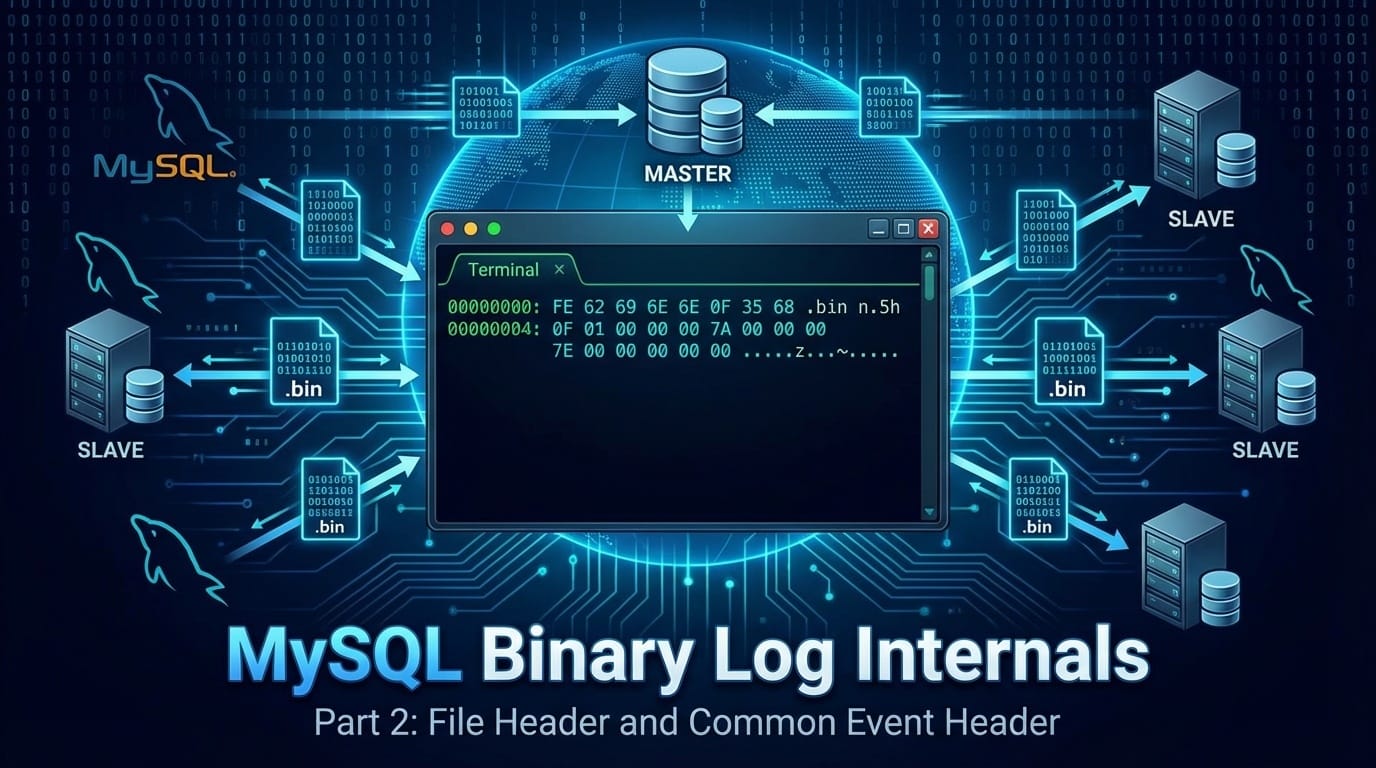
In this second post of our series, we examine the binary log file header and the 19-byte common event header that every event shares. The Binary Log File Header (Magic Number) Every MySQL binary log file begins with a 4-byte magic number that identifies it as a binary log: Bytes Hex ASCII Meaning 4 FE 62 69 6E .bin Unencrypted binary log 4 FD 62 69 6E .bin Encrypted binary log The first byte distinguishes encrypted (0xFD) from unencrypted (0xFE) logs. For encrypted logs, an

Marcelo Altmann
2026-03-04 · 5 min read
In this second post of our series, we examine the binary log file header and the 19-byte common event header that every event shares.
Every MySQL binary log file begins with a 4-byte magic number that identifies it as a binary log:
| Bytes | Hex | ASCII | Meaning |
|---|---|---|---|
| 4 | FE 62 69 6E | .bin | Unencrypted binary log |
| 4 | FD 62 69 6E | .bin | Encrypted binary log |
The first byte distinguishes encrypted (0xFD) from unencrypted (0xFE) logs. For encrypted logs, an additional 508 bytes of encryption metadata follow the magic number.
Let's verify this with our binary log file:
$ xxd -l 4 binlog.000024
00000000: fe62 696e                                .bin
We see fe 62 69 6e — this is an unencrypted binary log. The ASCII representation on the right shows .bin (the 0xFE byte isn't a printable character, so xxd shows a dot).
Checkpoint: Position 0-3 = Magic number. The first event starts at position 4.
Every event in the binary log (version 4+) shares a common 19-byte header structure. This header tells us the event's type, size, and position in the log:
| Field | Size | Description |
|---|---|---|
| Timestamp | 4 bytes | Unix epoch seconds when the event was created |
| Event Type | 1 byte | Identifies how to interpret the payload |
| Server ID | 4 bytes | The server that originated this event (prevents circular replication) |
| Event Size | 4 bytes | Total size of this event in bytes (header + payload) |
| Next Position | 4 bytes | File offset where the next event begins |
| Flags | 2 bytes | Event-specific flags (bit field) |
Let's read the first event header from our binary log. The first event starts at position 4 (right after the magic number):
$ xxd -s 4 -l 19 -c 19 binlog.000024
00000004: 6e0f 3568 0f01 0000 007a 0000 007e 0000 0000 00  n.5h.....z...~....
The hex bytes are: 6e0f3568 0f 01000000 7a000000 7e000000 0000
Let's decode each field:
6e0f3568Remember, this is little-endian! We read it as 0x68350f6e:
0x68350f6e = 1748307822 (decimal)
Converting to a human-readable date: 2025-05-27 01:03:42 UTC
0fThe event type is 0x0f = 15, which is FORMAT_DESCRIPTION_EVENT. This is always the first event in a binary log file — it describes the format of all subsequent events.
01000000Little-endian: 0x00000001 = 1
This is the server_id of the MySQL instance that created this event.
7a000000Little-endian: 0x0000007a = 122 bytes
This is the total size of the event, including the 19-byte header and any checksum.
7e000000Little-endian: 0x0000007e = 126
The next event in the file starts at byte position 126. We can verify: 4 (start) + 122 (size) = 126 ✓
00000x0000 = no special flags set for this event.
Let's visualize our decoding:
Position 4-22 (Event Header):

6e0f3568 0f 01000000 7a000000 7e000000 0000
│        │  │        │        │        │
│        │  │        │        │        └─→ Flags: 0x0000
│        │  │        │        └───────────→ Next Position: 126
│        │  │        └────────────────────→ Event Size: 122 bytes
│        │  └─────────────────────────────→ Server ID: 1
│        └────────────────────────────────→ Event Type: 15 (FORMAT_DESCRIPTION_EVENT)
└─────────────────────────────────────────→ Timestamp: 1748307822 (2025-05-27 01:03:42)
Here are the event types we'll encounter in this series:
| Type ID | Hex | Name | Description |
|---|---|---|---|
| 2 | 0x02 | QUERY_EVENT | DDL statements, transaction BEGIN |
| 4 | 0x04 | ROTATE_EVENT | Log rotation marker |
| 15 | 0x0f | FORMAT_DESCRIPTION_EVENT | Binary log format descriptor |
| 16 | 0x10 | XID_EVENT | Transaction commit marker |
| 19 | 0x13 | TABLE_MAP_EVENT | Table structure for row events |
| 30 | 0x1e | WRITE_ROWS_EVENT | Row insert data |
| 31 | 0x1f | UPDATE_ROWS_EVENT | Row update data (before + after) |
| 32 | 0x20 | DELETE_ROWS_EVENT | Row delete data |
| 33 | 0x21 | GTID_LOG_EVENT | Global Transaction ID |
| 35 | 0x23 | PREVIOUS_GTIDS_LOG_EVENT | GTIDs from prior logs |
Every event in a binary log follows this pattern:
┌───────────────────────────────────────────────────┐
│              Common Header (19 bytes)             │
├───────────────────────────────────────────────────┤
│         Event-Specific Payload (variable)          │
├───────────────────────────────────────────────────┤
│              CRC32 Checksum (4 bytes)             │
└───────────────────────────────────────────────────┘
The 4-byte CRC32 checksum at the end is included when checksums are enabled (default since MySQL 5.6.2). The checksum covers the entire event from header through payload.
Using the header information, we can traverse the entire binary log:
event_size to know total event lengthnext_position to find the next eventHere's how the first few events chain together in our log:
Position     0: Magic Number (4 bytes)
Position     4: FORMAT_DESCRIPTION_EVENT → Next: 126
Position   126: PREVIOUS_GTIDS_LOG_EVENT → Next: 197
Position   197: GTID_LOG_EVENT → Next: 276
Position   276: QUERY_EVENT (CREATE TABLE) → Next: 458
...
Here are some commands to explore:
# View the magic number
xxd -l 4 binlog.000024

# View the first event header
xxd -s 4 -l 19 binlog.000024

# View the second event header (at position 126)
xxd -s 126 -l 19 binlog.000024
Or with Python:
import struct
from datetime import datetime

with open('binlog.000024', 'rb') as f:
    magic = f.read(4)
    print(f"Magic: {magic.hex()} = {magic}")

    header = f.read(19)
    timestamp, event_type, server_id, event_size, next_pos, flags = \
        struct.unpack('<IBIIIH', header)

    print(f"\nEvent Header:")
    print(f"  Timestamp: {timestamp} ({datetime.utcfromtimestamp(timestamp)})")
    print(f"  Event Type: {event_type}")
    print(f"  Server ID: {server_id}")
    print(f"  Event Size: {event_size}")
    print(f"  Next Position: {next_pos}")
    print(f"  Flags: 0x{flags:04x}")
Now that we understand the file header and common event header structure, we're ready to decode specific event types. In the next post, we'll examine the FORMAT_DESCRIPTION_EVENT — the critical first event that tells MySQL (and us) how to interpret everything that follows.
Next up: Part 3: FORMAT_DESCRIPTION_EVENT — The Self-Describing Event
This series is based on a presentation given at the MySQL Online Summit. The goal is to help MySQL users understand what goes under the hood of replication by manually decoding binary log files.
Related articles
Continue reading more about mysql.
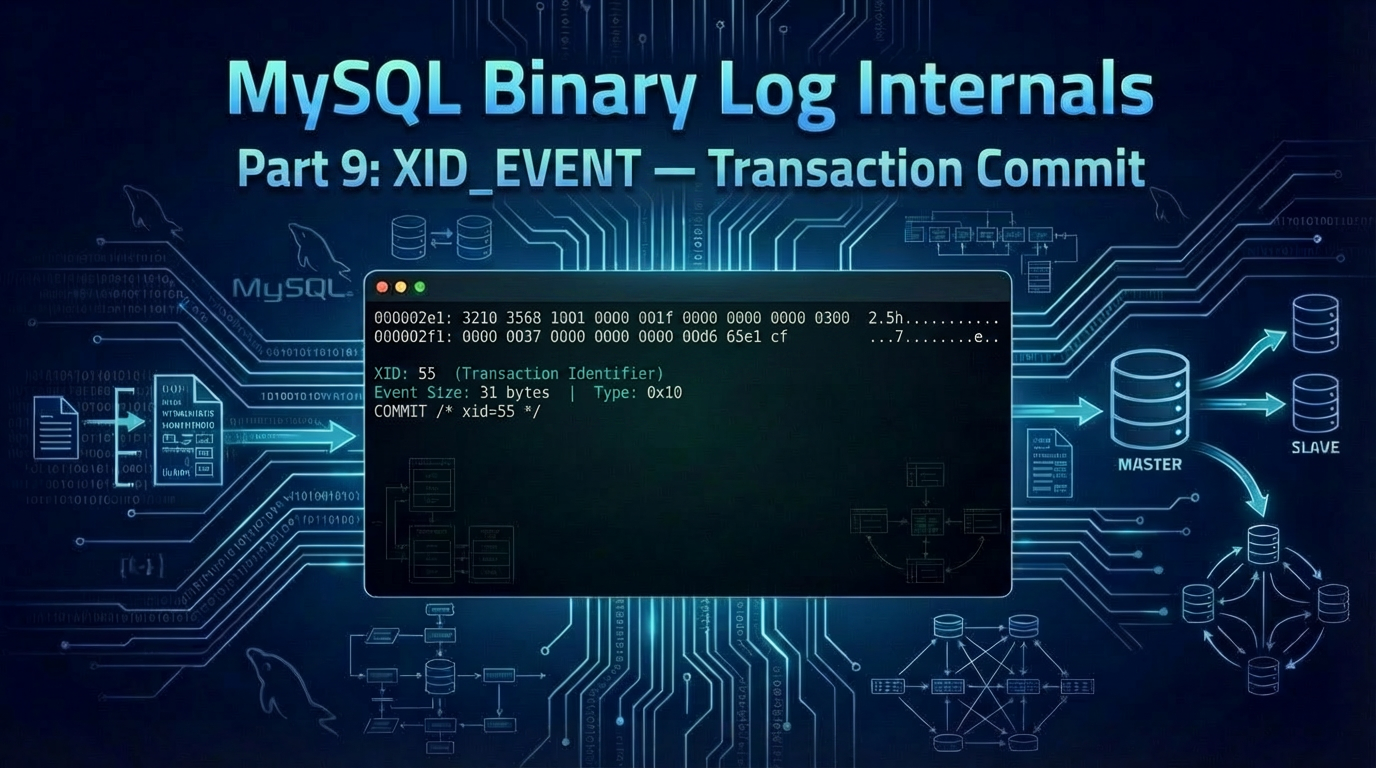
In this ninth post of our series, we decode the XID_EVENT — the smallest event in the binary log, and the one that marks every transactional commit. Introduction Every DML transaction we've decoded so far ends the same way: with an XID_EVENT (event type 16, 0x10). At only 31 bytes on the wire, it carries a single piece of information — an 8-byte transaction identifier — but it does some of the heaviest lifting in MySQL replication. The XID_EVENT is what allows replication to be crash-safe wit
Marcelo Altmann
One of the most requested features since Readyset first supported MySQL has been GTID-based replication. With the latest release, Readyset now fully supports MySQL Global Transaction Identifiers (GTIDs), and with it, a capability that changes how you think about cache durability: zero-downtime failover. This post covers what GTID support means for Readyset users, how failover works in practice, and why this matters for anyone running Readyset in production. The Problem with Binlog File and Po
Marcelo Altmann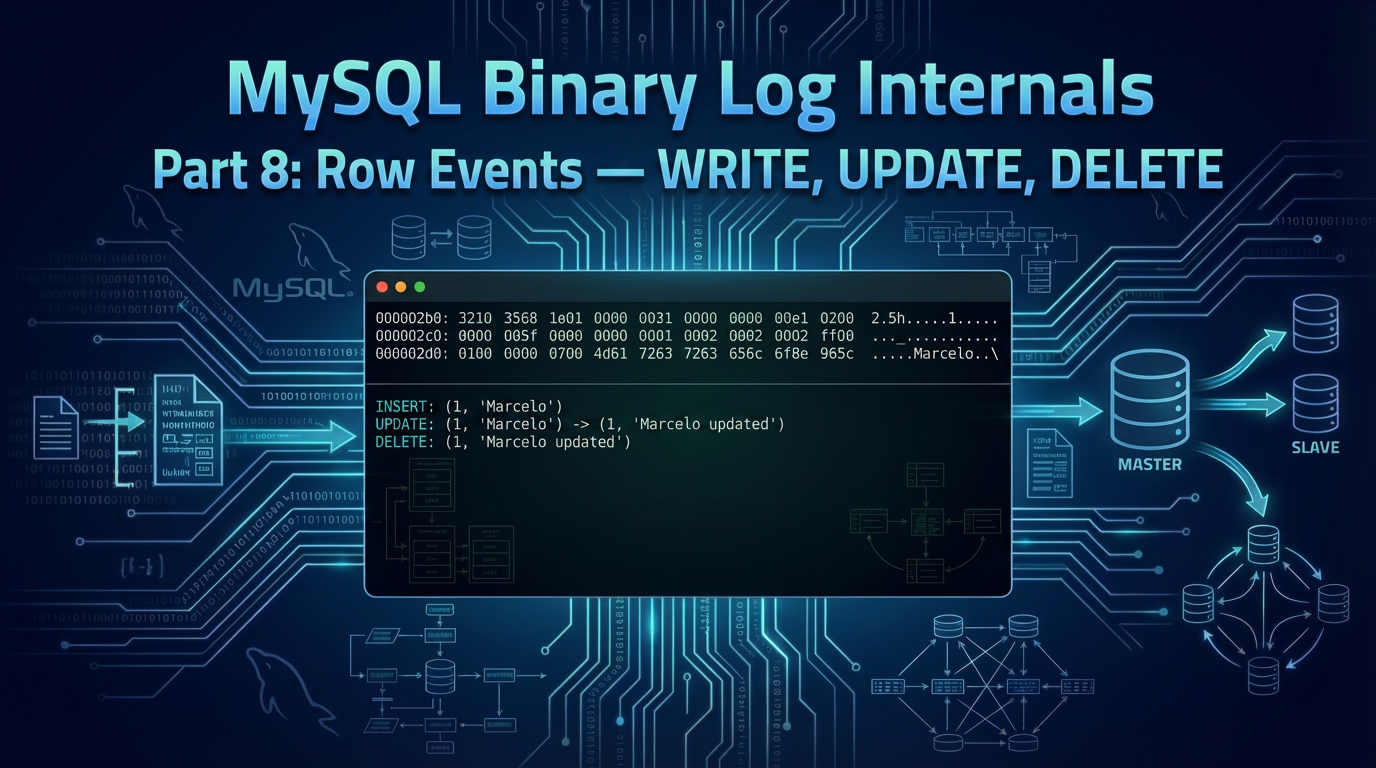
In this eighth post of our series, we decode the three row events — WRITE_ROWS_EVENT, UPDATE_ROWS_EVENT, and DELETE_ROWS_EVENT — that carry the actual row data for INSERT, UPDATE, and DELETE operations in row-based replication. Introduction In the previous posts, we decoded the events that set the stage for row-based replication: the GTID_LOG_EVENT identifies the transaction, the QUERY_EVENT opens it with BEGIN, and the TABLE_MAP_EVENT describes the table's schema. Now we finally arrive at th
Marcelo AltmannModern applications demand instant performance, even under unpredictable load. Readyset helps you eliminate slow queries, stabilize latency, and scale confidently.
Revolutionize your database performance with Readyset
Serve requests at sub-millisecond latencies with the modern database scaling and query caching system for MySQL and PostgreSQL.
Join our newsletter
Stay updated with the latest news, insights, and developments from Readyset — straight to your inbox.